TL;DR: GEO (Generative Engine Optimization) is the work of shaping content so AI search engines cite it in their answers. The term was coined in 2023 by researchers at Princeton and Georgia Tech. The mechanics differ from Google ranking: an AI system breaks a query into several sub-queries, pulls individual passages, and assembles an answer from them. This article separates GEO, SEO, AEO and LLMO, looks at what the data actually shows, and marks the limits of the discipline.
What GEO is
GEO is short for Generative Engine Optimization. It means arranging your content so generative engines, ChatGPT, Perplexity, Google AI Overviews, pick it up and cite it in their answer.
The term is not a marketing invention. It was coined by researchers Pranjal Aggarwal, Vishvak Murahari and colleagues at Princeton and Georgia Tech. The paper first appeared as an arXiv preprint in November 2023, then at KDD 2024. They describe GEO as "the first paradigm to help creators improve the visibility of their content in generative engine responses".
Why now? Because search behaviour is shifting. According to SparkToro, 68.01% of Google searches in the first four months of 2026 ended without a single click, up from 60.45% in 2024. When an AI answer appears, clicks drop. Ahrefs measures the click drop on the first organic result growing from 34.5% (April 2025) to 58% (December 2025) when an AI Overview is present.
Users increasingly get the answer without visiting a page. The question is no longer only whether you rank. It is whether the AI cites you while assembling that answer.
GEO, AEO, LLMO: the same thing or not?
This is where the confusion starts. Three acronyms, often the same meaning, and no agreement on the boundaries.
AEO (Answer Engine Optimization) is the older term. It is credited to Jason Barnard of Kalicube, who introduced it in 2017 – 2018, five or six years before GEO. LLMO (LLM Optimization) is the widest umbrella. IDC treats it as the parent concept and GEO as its subset. In practice, AEO and GEO are mostly used interchangeably.
Google does not rule either. Its own documentation mentions both AEO and GEO but endorses neither as correct.
What does not exist: an authoritative study or Google Trends figure telling us which term "wins." Nobody has measured it. So take any claim about "the one correct name" with caution.
A practical split looks like this:
- SEO, ranking on the classic list of blue links.
- AEO, optimizing for direct answers: featured snippets, voice assistants, "answer" boxes.
- GEO, optimizing for generative answers the AI composes into text.
- LLMO, the broader term: visibility in large language models in general.
How AI systems choose who to cite
This is the real difference from SEO. It is not in the name. It is in the mechanics.
Google classically returns one ranked list. An AI engine works differently. It uses RAG and so-called "query fan-out": your query is broken into several sub-queries, sent to different sources, results are pooled, and only then does the language model select and assemble passages into an answer.
The consequence matters. The AI does not choose a whole page. It chooses the individual passage that best answers a sub-query. A page can be excellent overall yet invisible if no passage is written to answer a question on its own.
If you want to understand that mechanism in depth, we break it down in how AI search engines choose who to cite.
What the data shows about overlap with SEO
Every SEO's first question: is GEO anything new, or the same work under a new name? The data gives a mixed answer.
Semrush analyzed 5,000 keywords and roughly 150,000 citations. Overlap with Google's organic top 10 varies sharply by platform: Perplexity 91% at the domain level and 82% at the URL level; Google AI Overviews 86% and 67%; Google AI Mode 54% and 35%; ChatGPT lowest, 45% and 28%.
In other words: those who dominate Google often show up in the AI answer too. But the more generative the platform, the smaller the overlap.
The same Semrush study shows that pages ChatGPT Search cites sit at position 21 or lower in classic Google almost 90% of the time. So content that was never on the first page can still end up in an AI citation.
The overlap data is not even settled. BrightEdge measured, over 16 months, the overlap of AI Overview citations with organic rankings rising from 32.3% to 54.5%, yet only 16.7% of citations come from the organic top 10. By contrast, an analysis relayed in one research review attributes to Ahrefs a March 2026 figure of only 37.9% of cited URLs in the organic top 10, a drop from earlier estimates. The two numbers disagree. We do not pick one and do not average them; we say the picture is unstable.
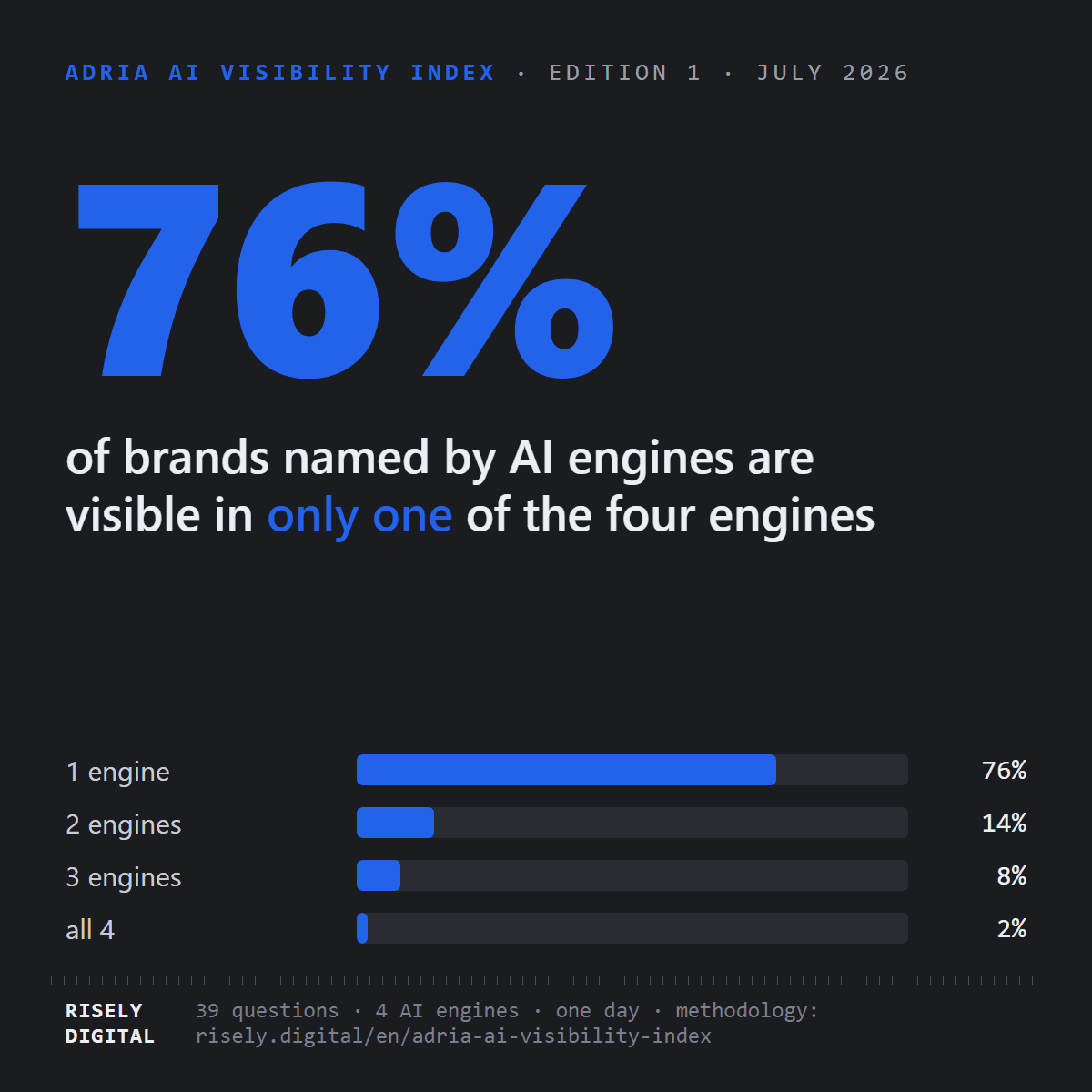
That is why measuring visibility per individual AI engine makes sense as its own task, rather than assuming Google ranking covers it all. We follow that logic through the Adria AI Visibility Index.
What GEO work actually is
Now that we know the mechanics, here is what has an evidence base.
The same Princeton paper tested concrete tactics. Adding citations, quotes and statistics to content produced a relative improvement of 30 – 40% on the visibility metric, and above 40% aggregated across query types; up to 37% live on Perplexity. Notably, stylistic edits alone, better readability, clearer phrasing with no new facts, produced a visibility boost of 15 – 30%.
The paper also shows redistribution. Applying GEO tactics increased the visibility of a fifth-ranked page by 115.1%, while the top-ranked page's visibility fell on average by 30.3%. GEO changes who gets cited, not just how much.
What has no evidence base is just as important. CXL warns that schema and markup alone cannot compensate for a weak answer, engines favour content that is authoritative and up to date. Keyword-density tricks do not help here.
In short: GEO work is good content, backed by numbers and sources, written so each passage answers a question on its own. We put the concrete steps into the GEO checklist. When that work needs to be done systematically, it runs through GEO optimizacija.
Is GEO even a new discipline?
It is worth hearing the other side. Part of the industry argues GEO is mostly repackaged SEO.
In March 2026 Digiday quoted veterans. Jeremy Moser, co-founder of the agency uSERP, says "80% of GEO is good, fundamental SEO" and that anyone who won't admit it is "selling you snake oil". Lily Ray of Amsive is blunt: anyone pretending to be a GEO expert is "lying".
The skepticism runs deeper. An earlier Digiday story cites publishers who doubt GEO drives measurable traffic; Neil Vogel, CEO of People Inc., asks a simple question, can anyone prove they know how to optimize the output of these tools.
There is data that backs the caution. According to a study relayed in one review, the same query in Google AI Mode returned 91% different URLs across three consecutive searches on the same day. If cited sources shift that much hour to hour, promises of "precise, reproducible optimization" deserve a hard look.
Our conclusion: GEO is not magic, and it is not a separate universe cut off from SEO. Most of it is good SEO, plus a few actions specific to how AI selects passages.
GEO in Croatia
The local context is thin on data, and that is part of the story.
Netokracija covered the arrival of Google AI Overviews in Croatia. Their estimate, extrapolated from global trends, is a drop in clicks of between 10 and 40 percent, depending on the type of search. Google AI Mode became available in Croatia on 15 October 2025, after AI Overviews landed in mid-May 2025.
What is missing: a serious local piece on the GEO/AEO/LLMO terminology mess itself, and public data on the share of ChatGPT or AI Overviews versus classic Google for the Croatian market. Those numbers simply do not exist, so we do not invent them. If you want to measure where AI currently sees you, start with a free GEO Audit.
Frequently asked questions
Is GEO the same as SEO?
No, but they overlap heavily. SEO targets ranking on a list of links. GEO targets citation inside an AI answer. Part of the industry argues around 80% of GEO is still good, fundamental SEO, with the rest being actions adapted to how AI selects passages.
GEO, AEO or LLMO, which is the right term?
There is no verdict. AEO is the older term, LLMO the wider umbrella, and GEO is often used as a synonym for both. Google's documentation mentions both AEO and GEO without favouring either. No study has measured which name prevails.
Why does AI cite pages that aren't on Google's first page?
Because AI does not copy Google's list. It breaks the query into sub-queries, pulls passages from several sources, and assembles an answer. That is why pages ChatGPT cites sit at position 21 or lower in classic Google almost 90% of the time.
Is there proof that GEO tactics actually work?
Yes, limited. The Princeton paper shows a visibility gain of over 40% from adding citations, quotes and statistics, and 15 – 30% from improving readability alone. At the same time, cited sources are highly unstable day to day, so there is no guarantee of a reproducible result.
Is SEO dead because of GEO?
No. Classic search still drives traffic, and the overlap between AI citations and organic ranking is measured in tens of percent. What changes is that some users get an answer without a click, so visibility inside AI answers becomes an additional channel, not a replacement.
Keep reading: We asked 4 AI engines about Croatian brands · The GEO checklist