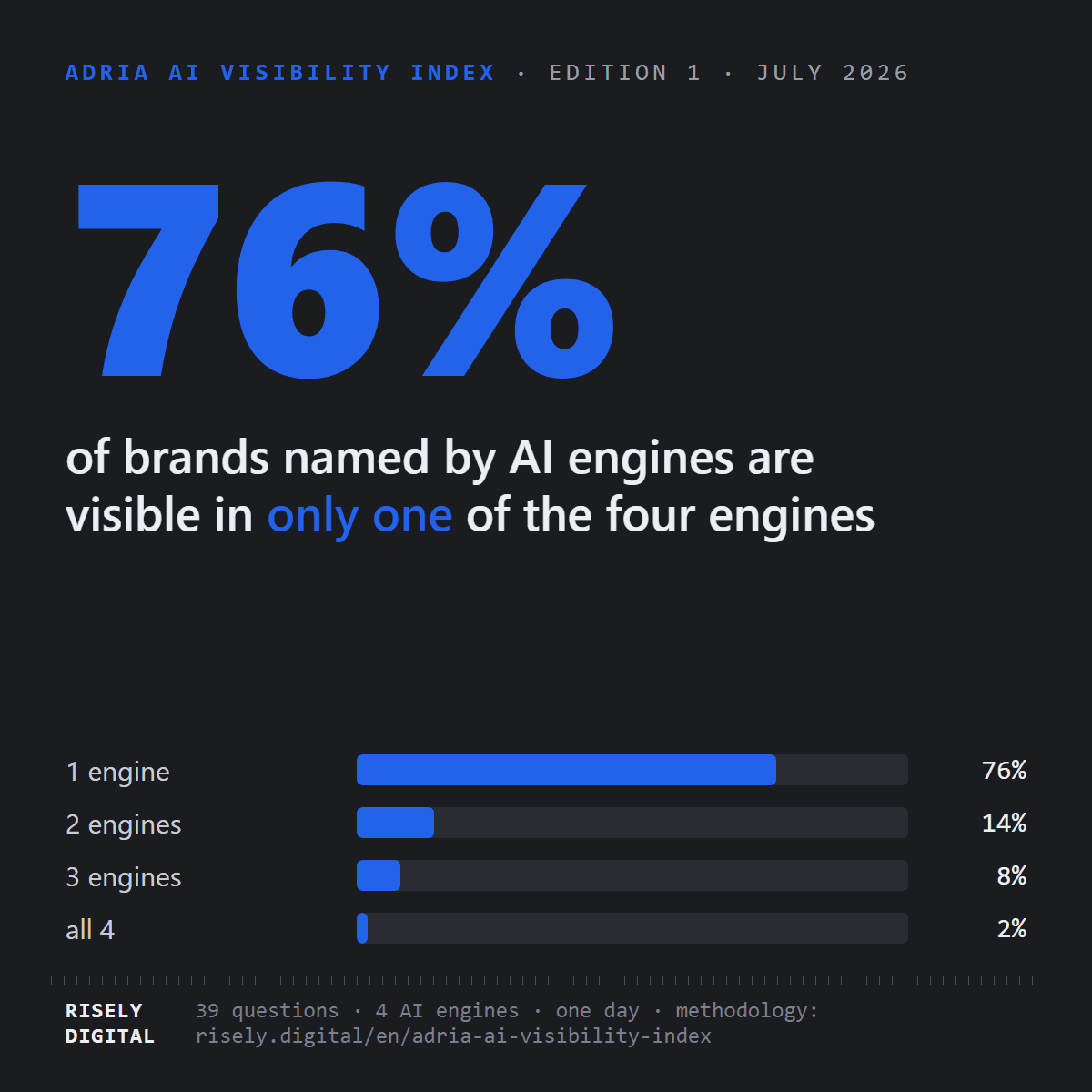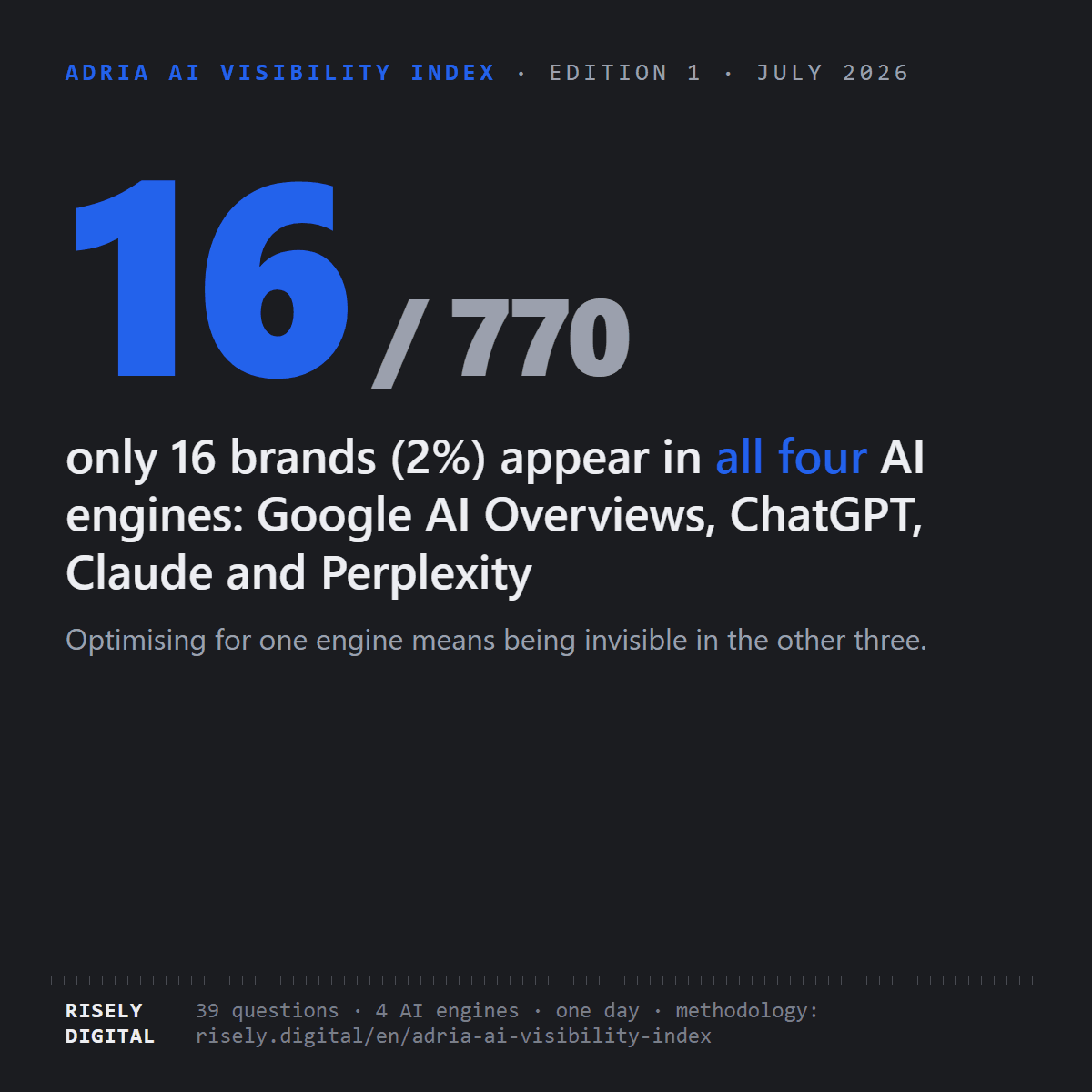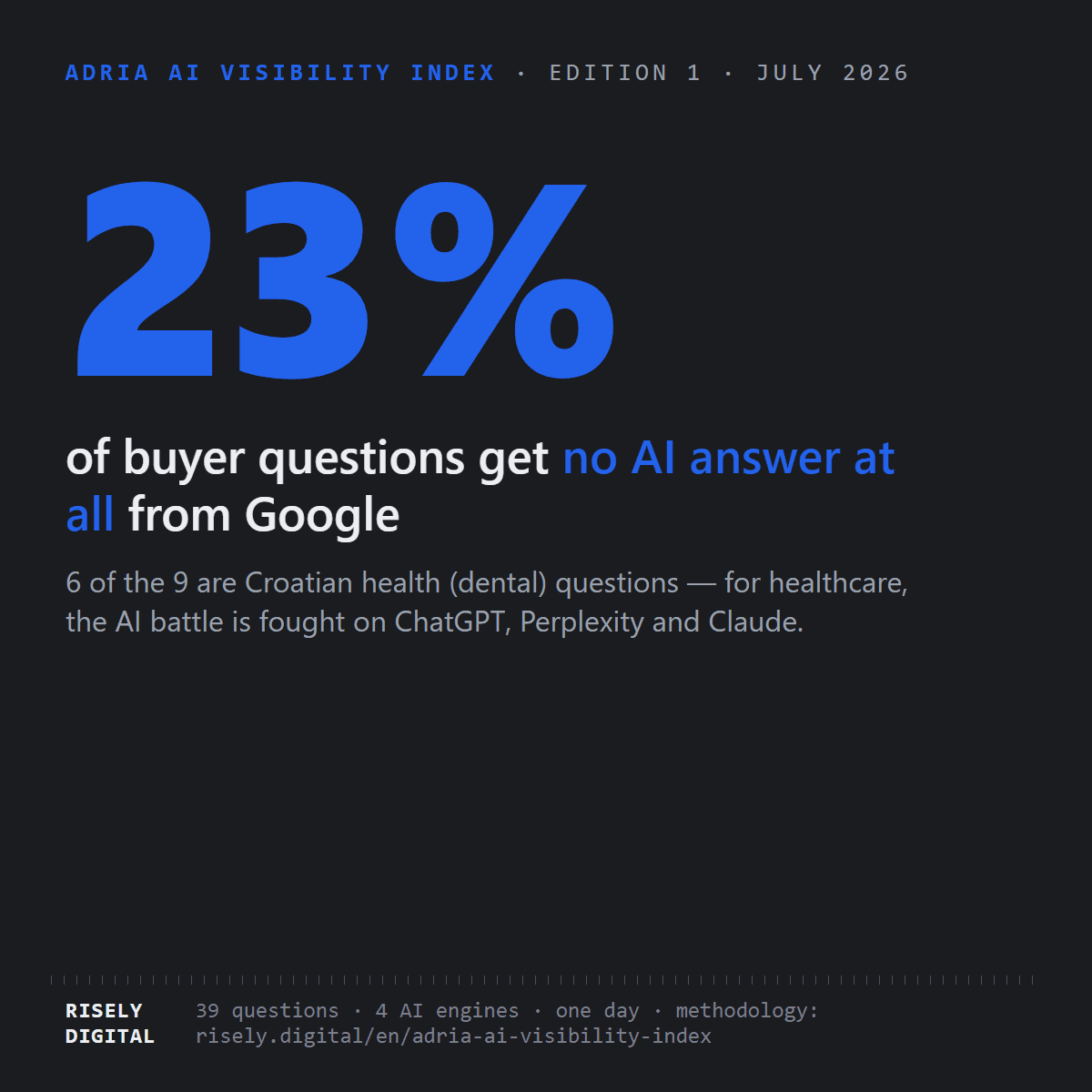
TL;DR: We asked four AI search engines the same 39 real buyer questions, from "best dental clinic in Zagreb" to "recommend a CRM for a small business", all on the same day: Google AI Overviews, ChatGPT, Claude and Perplexity. The result: of 770 brands named across the answers, 76% appear in only one of the four engines, and just 2% appear in all four. Google generates no AI answer at all for 23% of the questions. This is the first edition of a regional index that measures and publishes this visibility, with full methodology and every limitation stated.
Why this index exists
More and more buying decisions start with a question to an AI engine instead of a classic search. Yet nobody in the region systematically measures who those AI answers actually recommend, or which sources they build those recommendations from. Without data, "AI visibility" stays a marketing phrase.
The Adria AI Visibility Index changes that: one set of real buyer questions, four AI engines, everything recorded, which brands get named, which sources get cited, and where the engines agree versus completely diverge.
Methodology
- 39 questions across four industries: B2B SaaS & tech (11), finance & insurance (8), e-commerce & retail (8), dental (12). The questions simulate real buyers: "what's the best...", "recommend...", "compare...".
- Croatian and English, English where the buyer genuinely searches that way (dental tourism, enterprise B2B).
- Four engines, same day (14 July 2026): Google AI Overviews (location Croatia for Croatian questions, UK for English), ChatGPT (GPT-5 with web search), Claude (with web search, each question in an isolated session) and Perplexity (Sonar Pro). 156 answers in total.
- For every answer we recorded the brands named, the sources cited, and whether the engine explicitly said there is no single best option.
Limitations, stated openly: AI answers vary by day, session and model version, this is a snapshot of one day, not a fixed ranking. Appearance tables are not a statistical ranking: each sub-topic gets 1–2 questions, deliberately trading depth for breadth of buying situations. Claude was tested through an API with web search rather than the consumer app, so its "no clear winner" rate is not directly comparable to the others. A pilot edition with the same questions on a single engine, seven days earlier, produced consistent findings, a good sign for the stability of the method.
Key findings
1. Who is "visible in AI" depends on which engine you ask
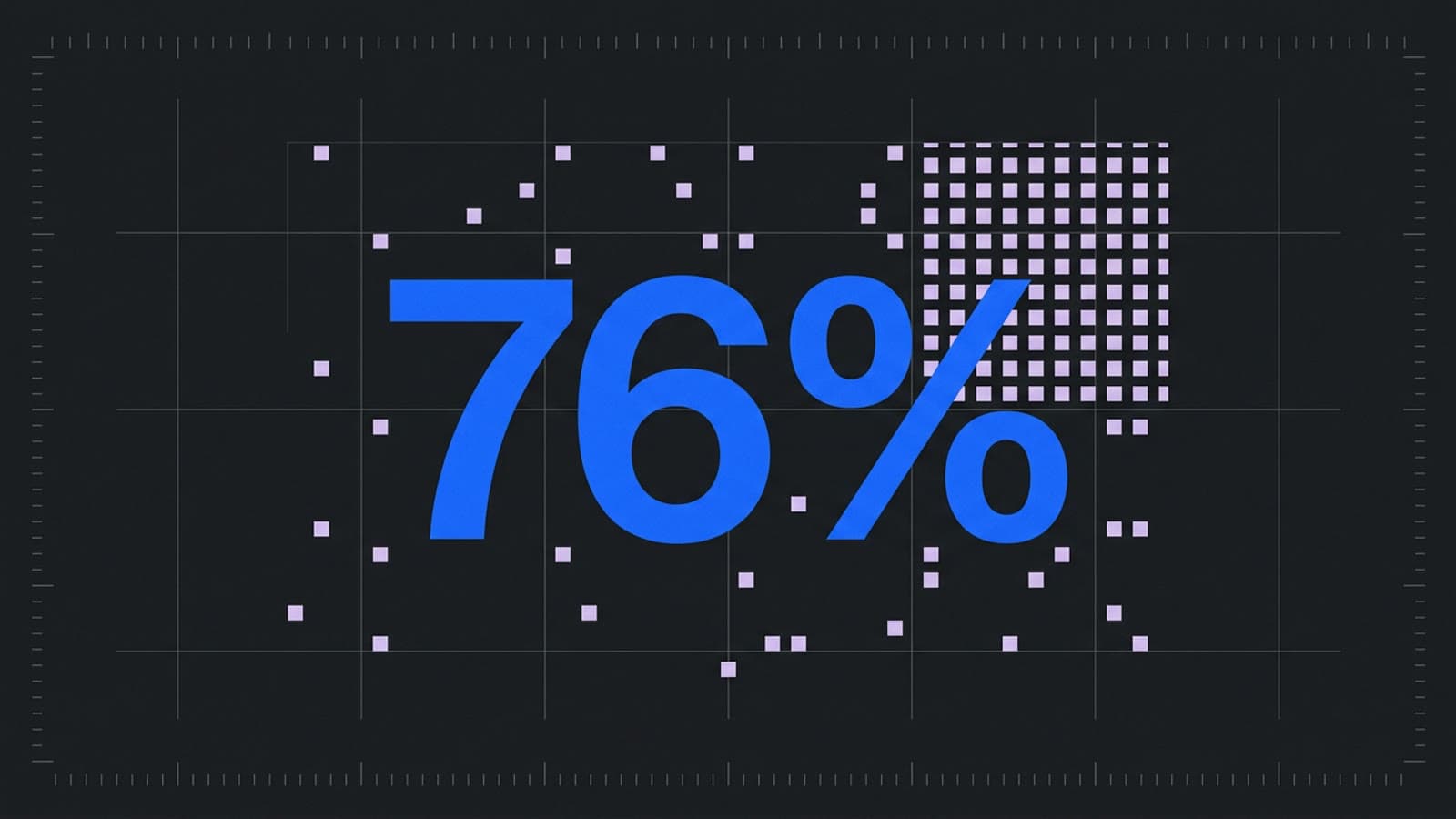
Of 770 named brands, 584 (76%) appear in exactly one engine. 14% appear in two, 8% in three, and only 16 brands, or 2%, in all four. Optimising visibility for a single engine means staying invisible in the other three.
2. The categories still have no owner
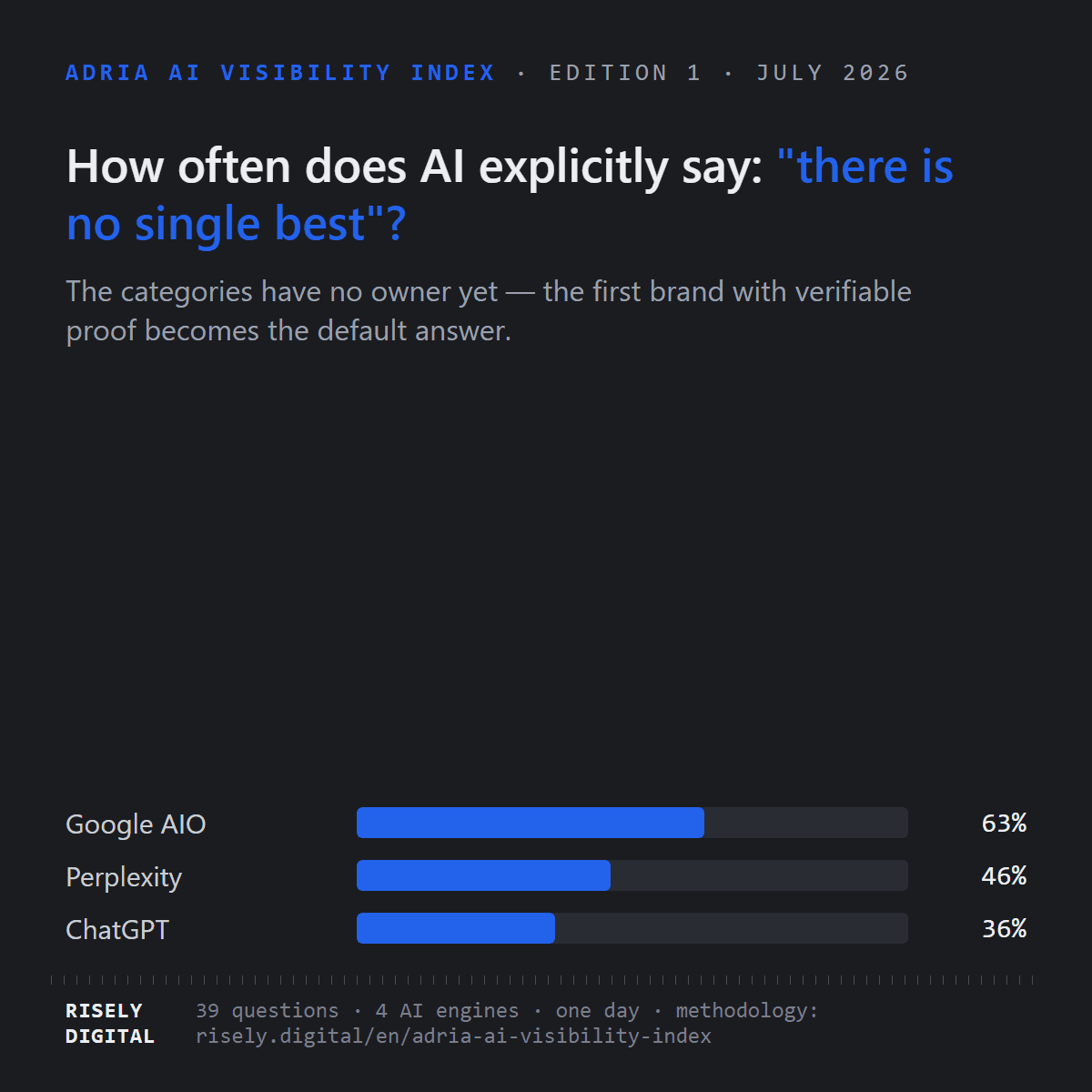
On a large share of questions the engines explicitly say there is no single best option: Google AI Overviews in 63% of its answers, Perplexity in 46%, ChatGPT in 36%. Where AI cannot name a winner, the winner hasn't been built yet, open ground for the first brand that assembles verifiable proof.
3. Google doesn't answer a quarter of the questions at all
No AI Overview appeared for 9 of 39 questions (23%), six of them Croatian dental queries (best clinic, paediatric dentistry, emergency care, implants). Google visibly holds back on health topics in Croatian. The practical consequence: for healthcare brands, the AI-visibility battle is fought primarily on ChatGPT, Perplexity and Claude.
4. Each engine builds answers from a different ecosystem of sources
Google AI Overviews leans on aggregators and directories. ChatGPT cites brands' own websites more than any other engine, alongside credentialed rankings (Clutch, The Manifest) and regulators. Perplexity has the broadest, most chaotic mix: niche directories, local media, even Reddit. Claude leans on Clutch for B2B and on international platforms for dental. There is no single GEO playbook for all engines, each has a different entry ticket.
5. Certifications and partner statuses have become an entry ticket into AI answers
Asked about the best e-commerce marketing agency, ChatGPT built its shortlist almost entirely from agencies with a published Google Premier Partner status, citing their own announcements. AI engines reward verifiable, publicly stated proof: certifications, awards, transparent pricing, concrete numbers.
6. Foreign patients still reach Croatian clinics through foreign platforms, with one big exception
On English dental-tourism questions, three of the four engines (Google, Perplexity, Claude) build their answers almost exclusively from international aggregators, Bookimed, Dental Departures, Qunomedical, Dentavacation. ChatGPT is the exception: it cites clinics directly, from their own English pages. A clinic with strong owned English content can win ChatGPT today, for the other three engines it has to be present on the platforms.
Findings by industry
B2B SaaS & tech
For generic software questions (CRM, ERP, project tools, document management) global tools dominate across all engines: SharePoint, M-Files, DocuWare, Monday, Trello, Asana. Local vendors break through as the "local partner at lower cost", not on raw functionality. In custom development there is consensus: Infinum, Q Agency, Serengeti and Undabot appear in three or four engines. For Croatian SaaS companies the core is Infobip, Fonoa, Oradian and Microblink. Notably, the term "GEO optimisation" is so new that ChatGPT didn't even parse it, it asked whether we meant generative or geospatial optimisation.
Finance & insurance
The most convergent industry: the big banks (Zagrebačka, PBZ, Erste, HPB, RBA, OTP) and insurers (Croatia, Allianz, Wiener, Generali) pass through practically every engine. Answers are decided by comparison sites (Kompare, Moj Bankar) and the regulator (HANFA). In the fintech niche, Aircash, KEKS Pay and CorvusPay appear consistently. New digital brands can enter fast, casco-insurance answers already include LAQO.
E-commerce & retail
The only category where one brand passes through all four engines: Marker, on the e-commerce marketing agency question. For webshop platforms the consensus is global (Shopify, WooCommerce); for marketplace reliability, Mall.hr and eKupi. But in product-retail niches (fashion, cosmetics, electronics) the brand sets are almost completely different per engine, stable "AI visibility" barely exists there yet, because there is no independent editorial layer for AI to build it from.
Dental
On Croatian questions the core is Videntis, Arena Dental, IMED, Bagatin and Rident, built from clinic websites and local directories. Google generates no AI answer for most Croatian dental questions. On English dental-tourism questions, finding no. 6 applies: whoever isn't on the international platforms doesn't exist for three of the four engines, while whoever has strong owned English content already earns direct ChatGPT citations today. Transparently published prices again get the most concrete answers, with exact euro amounts.
What this means for your brand
- Measure before you optimise. "Are we in AI answers" is not one question but four, one per engine. The answer changes week to week.
- Publish verifiable proof on your own pages. Certifications, awards, concrete numbers, transparent pricing, these are the signals engines cite, ChatGPT especially.
- Win the directories that feed your vertical. For agencies that's Clutch, for finance the comparison sites, for dental tourism the international platforms, for e-commerce the niche directories. Every vertical has its own entry ticket.
- If you sell to foreign buyers, you need English content and presence in the English-language source ecosystem. A translated website is not enough, answers are built from sources in the language of the question.
- An empty category is an invitation. Where AI says "there's no single best", the first brand with serious proof becomes the default answer.
Frequently asked questions
What is the Adria AI Visibility Index?
A regional study measuring which brands AI search engines actually recommend for real buyer questions, and which sources those recommendations are built from. Published with full methodology, limitations included.
How is a brand's AI visibility measured?
The same set of buyer questions is asked across multiple AI engines; for every answer we record which brands are named, in what order, which sources are cited, and whether the engine explicitly said there is no single best. Visibility is the frequency of appearance across engines and over time, not a one-off "are we in the answer".
Which AI engines does the index cover?
Four in this edition: Google AI Overviews, ChatGPT, Claude and Perplexity, each with web search, all on the same day, with identical questions.
Why do AI engines differ so much in their answers?
Each engine has a different retrieval stack: one leans on directories and aggregators, another on brands' own pages and credentialed rankings, a third on niche portals and forums. That's why 76% of named brands appear in only one engine, and why optimising for one engine doesn't buy visibility in the others.
Does being mentioned in an AI answer mean more enquiries and sales?
An AI answer is increasingly the buyer's first touch with a category, a brand in the answer makes the shortlist before the buyer has opened a single website. It doesn't replace the rest of your marketing, but categories are being claimed right now, while they are still empty.
How can I check where my brand appears?
Run the free GEO Audit, it checks whether your brand shows up in AI answers and whether your pages meet the conditions to be cited. For a deep dive into your category, get in touch.
How often is a new edition published?
The methodology is automated and repeatable, so we can rerun the same questions continuously and track changes over time. The next edition is planned with additional industries.
The index was produced by the Risely Digital team. Every question, answer and cited source is recorded and kept in raw form, every percentage in this text is verifiable. If you want your industry in the next edition, get in touch.