In reality, the opposite is often true. Google Ads reports an excellent ROAS. Meta claims credit for a large share of your sales. Google Analytics shows one set of numbers, your CRM shows another, and at the end of the month your finance team asks just one question – how much did marketing actually contribute to business growth?
It’s a question I hear more and more often from CEOs and leadership teams. And honestly, I think it’s completely justified. Marketing can no longer be a department that reports clicks, impressions, or conversion rates. Its role is to create measurable business value, which means the KPIs we track need to evolve as well.
That doesn’t mean CTR, CPC, or ROAS are no longer important. Performance teams will continue to use them every day to optimize campaigns. However, when it comes to strategic marketing management, the focus is increasingly shifting toward indicators that connect marketing activities with revenue, profitability, and long-term business growth.
Below are the KPIs I believe will be among the most important for every CMO in 2026.
1. MER is the KPI that connects marketing with business performance
For years, ROAS has been one of the most important metrics in performance marketing, and there’s no reason to stop tracking it. It remains an excellent indicator for campaign optimization, comparing ads, or evaluating the performance of individual channels.
The problem begins when ROAS becomes the only KPI used to make business decisions. It doesn’t know your profit margins, shipping costs, product returns, or customer support expenses. Two campaigns can deliver exactly the same ROAS while one generates twice as much profit.
For example, an eCommerce store selling high-margin products might achieve a ROAS of 4, while another store with much lower margins reaches a ROAS of 6. If you only look at ROAS, the second campaign appears more successful. However, once you include actual profitability and total marketing investment, the picture often changes completely. That’s why more mature organizations are shifting their focus from individual campaign performance to marketing’s overall contribution to business results.
This is where MER (Marketing Efficiency Ratio) becomes increasingly important. Unlike ROAS, which measures revenue against ad spend within a specific platform or campaign, MER measures total revenue against total marketing investment. In other words, it answers a much more strategic question: how effectively is marketing contributing to the business as a whole?
This is especially relevant today because the customer journey has become significantly more complex. A customer may first discover your brand on Instagram, read a Google search result a few days later, open one of your newsletters, and finally convert through a Google Ads campaign. Every platform will try to claim the conversion, but the business only cares about one thing – the final outcome.
2. CAC and LTV should always be analyzed together
One of the most common mistakes I see in marketing reports is treating customer acquisition cost separately from customer lifetime value.
Of course, it’s important to know how much it costs to acquire a new customer. However, that number alone says very little about the overall quality of your marketing.
Paying $150 to acquire a customer isn’t a problem if that customer generates $2,000 in revenue over the next three years while remaining profitable. On the other hand, a customer acquired for $30 can turn out to be a poor investment if they never purchase from you again.
That’s why CAC (Customer Acquisition Cost) only becomes meaningful when viewed alongside LTV (Lifetime Value). The relationship between these two metrics shows whether your marketing investment is sustainable and how much room you have for profitable growth.
This becomes particularly important in eCommerce, SaaS, subscription businesses, and any industry where customers make repeat purchases. In these business models, accepting a slightly higher CAC often makes perfect sense if it results in customers who stay loyal to your brand over the long term.
Research supports this approach. According to Bain & Company, increasing customer retention by just 5% can increase profits by anywhere from 25% to 95%. That’s why the goal of performance marketing shouldn’t be acquiring as many customers as possible at the lowest possible cost. The real objective is acquiring customers who create the greatest long-term value for the business.
3. Stop measuring Google, Meta, and SEO as separate channels
One of the biggest changes in performance marketing over the past few years has nothing to do with AI or automation. It’s about how people actually make buying decisions.
Today’s customers rarely convert after a single interaction with a brand. The customer journey is no longer linear. People research products, compare options, watch videos, read reviews, return multiple times, and only then decide to make a purchase. That’s why giving all the credit to the last click makes less and less sense.
Despite this, many companies still evaluate every marketing channel independently. Google Ads has its own ROAS, Meta reports its own conversions, SEO is measured through organic traffic, and email marketing focuses on open rates. While this approach may have worked a few years ago, today it often leads to poor business decisions.
It’s not uncommon for leadership teams to conclude that SEO isn’t generating enough conversions or that Meta Ads has become too expensive. Yet a deeper analysis often reveals that those very channels generated the first interaction with the customer, while Google Ads simply closed the sale. When every channel is analyzed in isolation, companies risk cutting investment in the activities that actually start the buying journey.
That’s why more organizations are moving toward omnichannel reporting and KPIs that evaluate marketing as one integrated system rather than a collection of disconnected activities. Only when you combine data from every channel with CRM and business performance can you make informed budget decisions.
Ultimately, customers don’t care which channel influenced their purchase. They care about the experience they had with your brand. It’s time our marketing dashboards reflected that reality.
4. Do you know how your brand is positioned in AI search?
Just a year or two ago, every conversation about organic visibility ended with the same question: “Where do we rank on Google?” Today, that’s no longer enough.
More and more users are turning to ChatGPT, Gemini, Claude, or Perplexity instead of traditional search engines. Rather than comparing ten different websites, they expect AI to recommend the best solutions instantly. If your brand isn’t among those recommendations, there’s a good chance you’ll never even make it onto the customer’s shortlist.
This isn’t limited to B2C businesses. Increasingly, B2B buyers are asking AI for recommendations on agencies, ERP systems, law firms, consultants, healthcare providers, and software solutions. In other words, AI is quickly becoming a new channel for discovering products and services.
That doesn’t mean SEO is becoming less important. Quite the opposite. Strong SEO is the foundation of good AI visibility, but AI models evaluate much more than search rankings. They analyze domain authority, content quality, mentions across trusted sources, structured data, factual consistency, and many other signals before deciding whether to recommend your brand.
That’s why AI Visibility is rapidly becoming one of the KPIs forward-thinking marketing teams will monitor. It will no longer be enough to know how much organic traffic comes from Google. You’ll also want to understand how often AI recommends your brand, for which prompts, in what context, and how you compare to your competitors.
If you haven’t yet seen how your brand appears from the perspective of ChatGPT, Gemini, or Perplexity, now is the time to do it. That’s exactly why we created the free Risely GEO Audit. It analyzes your brand’s visibility across AI search platforms, identifies where AI recommends you, where you’re missing entirely, and highlights your biggest opportunities to improve AI visibility. Even if you’re just starting to explore GEO, the audit will give you a clear picture of where you stand today.
5. More leads don’t necessarily mean more revenue
This is probably the topic where marketing and sales disagree most often. Marketing celebrates a 40% increase in leads. Sales responds by saying that half of those leads never became real business opportunities. The truth is, both teams are right – they’re simply looking at different parts of the funnel.
That’s why the total number of conversions is no longer enough. What’s far more important is understanding what happens after someone submits a form or completes a purchase. How many leads become customers? How much revenue do they generate? Do they purchase again? What is their long-term value?
As a result, more companies are connecting their CRM with Google Ads, Meta, and other advertising platforms while importing offline conversions back into those systems. This allows algorithms to optimize for real customers rather than just form submissions.
These situations are more common than many people realize. A campaign generating 200 average-quality leads isn’t necessarily more successful than one producing 120 leads if sales closes twice as many deals from those 120. That’s why marketing and sales should be working toward the same KPIs.
In practice, this often creates an interesting paradox. Lead volume may decrease, cost per lead may even increase, yet total revenue and profit continue to grow. If you only monitor marketing metrics, performance appears worse. If you monitor business metrics, marketing has actually become far more effective.
6. A dashboard that doesn’t change decisions has no value
Over the past decade, we’ve become incredibly good at collecting data. The challenge today isn’t getting access to numbers – it’s turning those numbers into decisions that improve business performance.
I’ve seen dashboards containing well over a hundred different metrics. They look impressive, but after the monthly leadership meeting, nobody changes budgets, adjusts strategy, or makes a different decision. When that happens, the problem isn’t the dashboard. It’s the KPIs. In my experience, the best dashboard isn’t the one displaying the most information. It’s the one that makes the next decision completely obvious.
Every KPI should answer a specific business question. If CAC increases, what will we do? If MER declines, which activities should we investigate first? If AI stops recommending our brand, who owns that problem? If lead quality drops, should we change our campaigns, landing pages, or sales process?
In other words, a KPI isn’t simply a number you present during a board meeting. It’s a tool that should help the business make better decisions. Marketing has made tremendous progress in becoming measurable. The next step isn’t collecting even more data – it’s choosing the right KPIs and using them to make better business decisions.
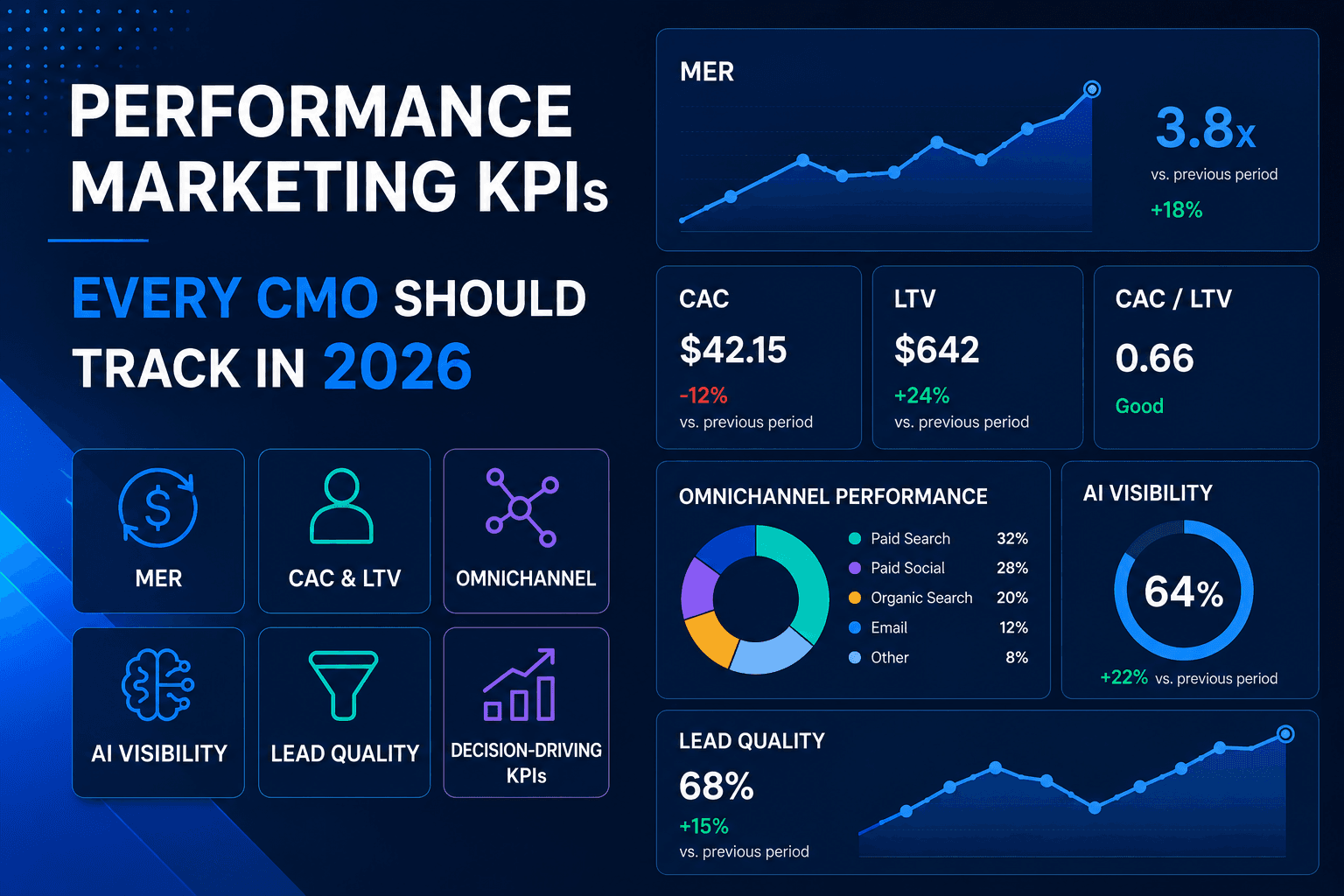
KPIs every CMO should have on their dashboard
- MER – Measures the overall efficiency of your marketing investment.
- CAC and LTV – Show whether customer acquisition is profitable in the long run.
- Omnichannel performance – Measures the contribution of every marketing channel, not just the last click.
- AI Visibility – Shows how visible and recommended your brand is across AI search platforms.
- Lead quality – Connects marketing performance with sales and actual revenue.
- Decision-driving KPIs – Because a dashboard only matters if it helps the business grow.
The most successful CMOs in 2026 won’t outperform their competitors because they have more data. They’ll win because they focus on the right KPIs – and use them to make faster, smarter business decisions.
Frequently Asked Questions
What is the most important KPI in performance marketing?
There isn’t a single KPI that fits every business model. While eCommerce companies often prioritize MER, ROAS, CAC, and LTV, B2B organizations usually focus more on lead quality, sales opportunity conversion rates, and revenue per customer. The most important KPIs are the ones aligned with your business goals, not just your advertising platforms.
What’s the difference between ROAS and MER?
ROAS (Return on Ad Spend) measures the revenue generated by a specific campaign or advertising platform relative to its ad spend. MER (Marketing Efficiency Ratio) measures total revenue against total marketing investment, providing a much more complete picture of overall marketing performance.
Why isn’t ROAS enough on its own?
ROAS doesn’t account for profit margins, operating costs, product returns, or customer lifetime value. A campaign can generate an excellent ROAS while delivering very little actual profit. That’s why it should always be evaluated alongside KPIs such as MER, CAC, and LTV.
Why should CAC and LTV be measured together?
CAC tells you how much it costs to acquire a customer, while LTV measures the total value that customer generates throughout their relationship with your business. Looking at both together helps determine whether your marketing investments are sustainable and profitable.
What is AI Visibility, and why is it becoming an important KPI?
AI Visibility measures how often your brand appears in responses generated by AI platforms like ChatGPT, Gemini, and Perplexity. As more users rely on AI to discover products and services, visibility within these platforms is becoming just as important as traditional Google rankings.
How can I measure my brand’s visibility in AI search?
The easiest approach is to analyze how AI platforms respond to prompts related to your products, services, or industry. Tools such as the Risely GEO Audit provide insights into how often AI recommends your brand, for which queries, and how you compare with competitors.
Why don’t more leads always mean better performance?
Generating more leads has little value if those leads never become customers. Businesses should focus on lead quality, conversion into sales, and the revenue generated by those customers rather than simply maximizing lead volume.
How can marketing be connected more closely with sales performance?
The most effective approach is connecting your CRM with advertising platforms like Google Ads and Meta while tracking offline conversions. This allows marketing teams to optimize campaigns based on actual customers and revenue rather than form submissions alone.
Keep reading: Google Performance Max: how it works and when it works against you · Performance marketing service