TL;DR: Performance Max is a single Google Ads campaign that runs across eight Google networks from one budget, with the algorithm allocating spend on its own. It works when you have enough conversions and clean signals. It works against you when it eats your brand search and inflates ROAS, in a controlled geo-test, excluding brand terms drove 24% more incremental revenue, and Google's reporting overstated PMax-with-brand by 33%. This guide shows how PMax actually works, when to set it up, and when to keep it away from a small account.
How it works
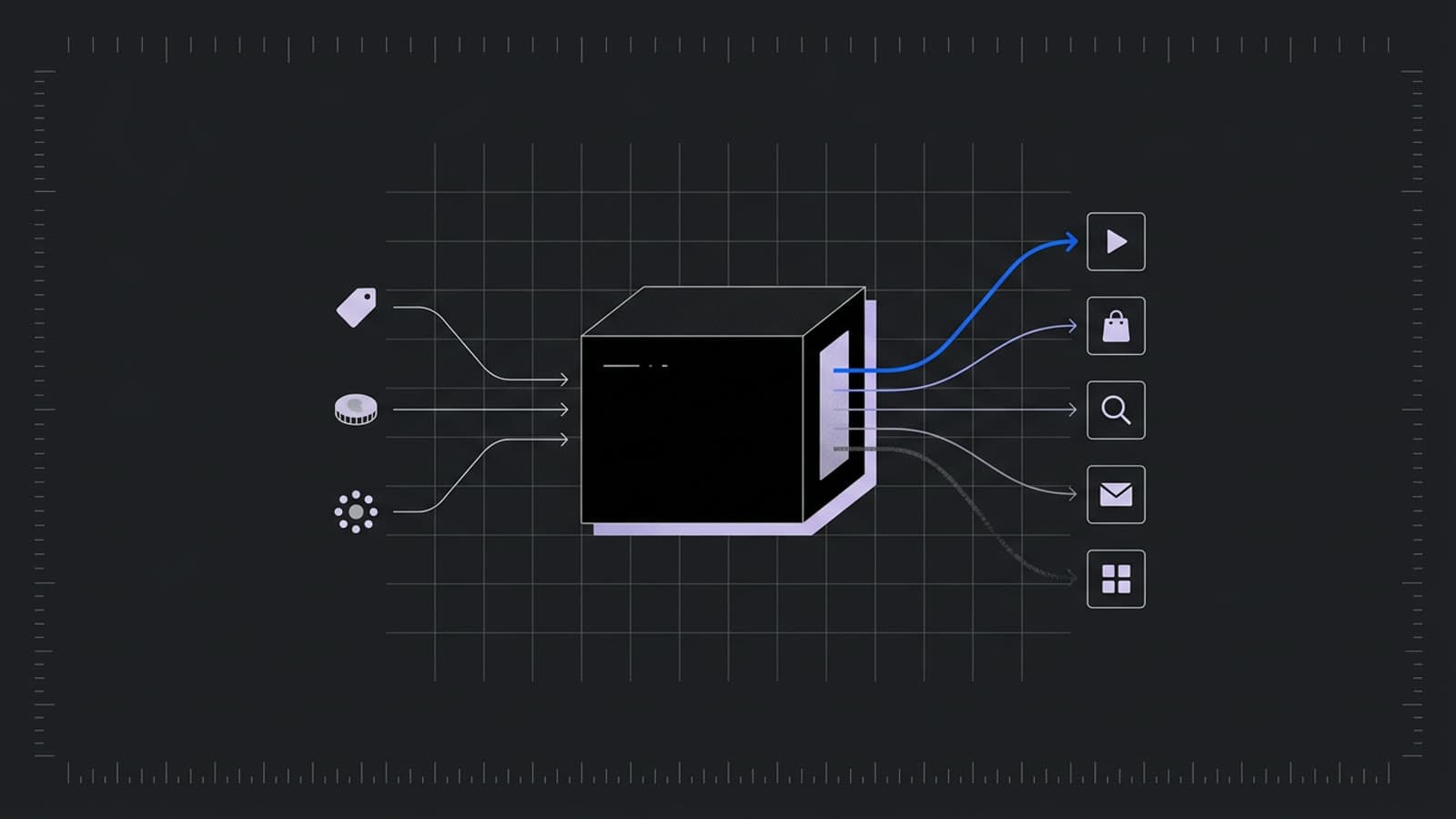
Performance Max is a single campaign type that covers nearly all of Google's inventory: Search, Shopping, Display, YouTube, Discover, Gmail, Maps, and the Search Partner Network. All from one budget, with two available bidding strategies, Maximize conversion value (with optional tROAS) and Maximize conversions (with optional tCPA), per Google's documentation.
For years the main complaint was the same: black box. You can't see where the money goes, you can't see which queries you show on, you have no levers to pull. That has changed noticeably in the last 12 to 18 months. Let's list what you actually hold in your hands today.
Channel-level reporting. Since 2025, tied to Google Marketing Live on May 21, 2025, PMax has a report showing spend, impressions, clicks, and conversions per individual channel, confirmed by Search Engine Land. But be careful: Google's own documentation explicitly warns against reacting to short-term per-channel ROI, because the algorithm optimizes across all channels together to maximize total conversion value, Google Ads Help. The report is for understanding, not micromanagement.
Search themes. You can add up to 50 phrases per asset group as a signal of where you want to go. These are additive, not exclusionary, they don't restrict PMax and don't override existing negatives, Google Ads Help.
Negative keywords. You can finally add negative keyword lists at account level and apply them to specific PMax campaigns, up to 1,000 terms per list, Google Ads Help. Until recently this was reserved for Search and Shopping only.
Brand exclusions. PMax has controls to exclude brand traffic, and from May 27, 2025 the Search-campaign version of those controls began migrating into AI Max, Google Ads Help.
Placement reporting was expanded too: from March 2024 it includes Search Partner Network sites, Google Ads Help. Again with the same caveat: Google says the placement report is a brand-safety tool, not a performance-evaluation report.
The takeaway for this section: PMax is no longer a total black box. But each of these reports ships with a "don't use this to measure performance" note. Transparency arrived for safety and hygiene, not for attribution.
When (not) to use it
Google loves quoting its own numbers. At launch in 2021 it claimed 13% incremental conversions at a similar cost per action, and by February 2023 that figure had risen to over 18%, Google Blog 2023. Keep two things in mind: these are Google's aggregate marketing claims, not independently audited, and they're 2021–2023 vintage.
Independent data is more useful. The most serious benchmark that exists, Smarter Ecommerce State of Performance Max 2025, states a clear thing: PMax needs 30 to 60+ conversions per month to work properly. The same source notes that PMax's share of total ad spend peaked around 82% in May 2024 and has since dropped about 6 points, advertisers are "slowly rediscovering" Standard Shopping and Search.
That's the point. PMax is not the default choice for every account. It needs food, conversions, history, signals. Below that threshold the algorithm has nothing to learn from.
And small markets like Croatia? Here Croatian practitioners are blunt. siite.hr advises: don't use PMax as your first campaign. Run Search first, gather data, then test PMax. The same source gives a realistic budget range for small businesses: an absolute floor around €300/month (and only for a narrow niche), an operational minimum of €500–800, and a solid start at €1,000–2,500/month.
Regional PPC practitioner adnanagic.com goes the same way: when the account is younger than three months, has fewer than 30 conversions per month, or a budget under €1,000/month, pick Standard Shopping, not PMax. And don't replace Standard Shopping with PMax; test PMax as an additional channel.
If you run a small account in the Croatian market, this is the most important part of the article. Thinner Search volume and less data mean the algorithm trains less and behaves more conservatively or erratically. Prove the unit economics on manual campaigns first. Well-built performance marketing campaigns give you the conversion base on which PMax later even makes sense.
Setup
Once you decide to go, here's what a hygienic setup looks like.
Audience signals are a hint, not a target. Google recommends Customer Match, custom audiences, and site-visitor lists as audience signals that accelerate learning, Google Ads Help. But PMax expands beyond them the moment it has enough data. Don't treat a signal as hard targeting.
Forget "one asset group per audience". The practitioner consensus for 2026 is clear: Google's algorithm reallocates budget regardless of how you slice audiences, and duplicate asset groups converge to the same average after four to six weeks, TopGrowthMarketing. Build asset groups by margin or product theme, and leave the "who" to Google.
One primary conversion with real value. Google's retailer guidance ties strong signals and clean, high-value primary conversions to better optimization, Google Ads Help. Fewer goals, real revenue value attached to the conversion. This is where a solid measurement setup pays off, Enhanced Conversions and clean tracking. The quality of your data and analytics setup directly determines how well PMax learns.
Learning phase and budget. Google says the learning phase lasts 1 to 2 weeks, sometimes up to 6, and that during that window you avoid frequent or large changes to budget, strategy, and targeting, Google Ads Help. Practitioners add specifics: don't cut budget by more than 20% in one move because you reset learning; make 10–15% steps, spaced 5 to 7 days apart; keep the daily budget around 10x target CPA during learning, DigitalApplied.
If you don't know which numbers to watch while the campaign learns, go through performance marketing KPIs before you touch a single slider.
When it works against you
This is the part the guide exists for. PMax has several known ways to work against you, and the best-documented is brand-search cannibalization.
Brand cannibalization. PMax happily takes your brand queries, people who were searching for you anyway, and attributes those conversions to itself. ROAS looks great, but you actually paid for traffic you'd get for free or far cheaper. This is the best-triangulated data point in the whole guide, because four sources with different methodologies all point the same direction.
The strongest evidence is the controlled geo-experiment by Haus.io: excluding brand terms drove 24% more incremental revenue on average and won on new-customer efficiency in 100% of experiments. The same test shows Google's reporting overstated PMax-with-brand performance by 33% versus the real geo-control ground truth.
Other sources give the range. GrowthSpree records 8 to 15% of spend going to brand queries on B2B SaaS accounts, inflating reported ROAS by 15 to 30%. And Adleverage estimates that in heavy-cannibalization scenarios only 20 to 30% of PMax-reported conversions are truly incremental.
The point isn't "PMax lies". The point is: without brand exclusions and without a geo-test, you don't know how much of that shiny ROAS is genuinely new revenue. Turn on brand exclusions. Where you can, test with a geo-holdout.
Placement quality. PMax pushes part of the traffic to Display and the Search Partner Network. You can see the placement report today, but Google explicitly labels it a brand-safety tool, not a performance evaluation, Google Ads Help. Translated: watch where you show for hygiene, but don't draw ROI conclusions from it.
PMax vs manual campaigns. The myth is that PMax always beats Search. The data doesn't confirm it. An Optmyzr study of 503 accounts found keyword overlap between Search and PMax in 91.45% of accounts. And where the CTR difference exceeded the "insignificant" 10% threshold, Search outperformed PMax in 28.37% of cases versus PMax outperforming Search in just 15.98% (with 55.65% showing no significant difference). Adalysis uses a different methodology and finds a clear winner: Search beats PMax on conversion rate in about 84% of overlapping terms.
So: don't let PMax quietly eat your Search campaigns on the assumption that it's "smarter". Keep Search alive, measure the difference, decide by the numbers.
FAQ
How many conversions per month does PMax need?
The independent benchmark from Smarter Ecommerce cites a minimum of 30, ideally 60+ conversions per month. Below that the algorithm doesn't have enough signal to learn.
Does PMax cannibalize my brand searches?
Yes, if you don't rein it in. The controlled geo-test by Haus.io showed 24% more incremental revenue with brand terms excluded and 33% overstated performance in Google's report. Turn on brand exclusions.
Should I launch PMax as the first campaign on a new account?
Not on a small or new account. Croatian practitioner siite.hr explicitly advises against PMax as the first campaign, run Search first, then PMax as an add-on.
How long does the learning phase last?
Google states 1 to 2 weeks, sometimes up to 6, Google Ads Help. During that window, don't make large budget or strategy changes.
Does PMax replace manual Search campaigns?
Not necessarily. Optmyzr shows that where performance differs significantly, Search wins nearly twice as often as PMax. Keep both channels and decide by the data.
If your PMax account shows a ROAS that looks too good to be true, it probably is, somewhere brand traffic or poor placement is hiding. Get in touch and we'll walk through your numbers together.