However, showing ads to users in Croatia does not mean that every Croatian company can already open its own Ads Manager account. Croatia is still marked as Coming Soon for self-service access on the official availability list.
The same distinction applies across much of Europe: ads are already appearing to users, while self-service advertiser access is still rolling out market by market. Advertisers in Croatia and other newly added European markets can explore the possibility of launching campaigns through the OpenAI Ads Solutions team or agency and technology partners involved in the rollout.
If a Croatian company has its own legal entity in a country where Ads Manager is already available, an account can be opened for that entity using business and billing information that genuinely belongs to it. A bank account, payment card or address in a supported country is not enough on its own.
Self-service access for Croatian advertisers is not open yet, but campaign preparation can begin immediately. Below, we explain how ChatGPT Ads work, what early results from other markets show and why organic visibility in ChatGPT should be developed alongside paid campaigns.
In short:
- ChatGPT Ads are now appearing to users in Croatia as part of the rollout across 31 European markets.
- Croatia is still marked as Coming Soon for self-service Ads Manager access on the official availability list.
- Ads are already live across Europe, but self-service advertiser access is still rolling out market by market.
- Croatian advertisers can explore campaign access through the OpenAI Ads Solutions team or agency and technology partners involved in the European rollout.
- Self-service access is currently available to advertisers in Australia, Brazil, Canada, Japan, South Korea, Mexico, New Zealand, the United Kingdom and the United States.
- Ads are shown to users on Free and Go plans; Plus, Pro, Business, Enterprise and Edu remain ad-free.
- The platform supports CPM, CPC and conversion-optimised CPC, context hints, geo-targeting, custom audiences, Pixel, Conversions API and product-feed campaigns.
- Early results show both significant potential and high volatility. Reliable universal benchmarks do not yet exist, as OpenAI itself confirms.
- Paid and organic presence are separate: ads do not influence ChatGPT responses, so it makes sense to build organic AI visibility through SEO and GEO alongside paid campaigns.
What is the current status of ChatGPT Ads in Croatia and Europe?
ChatGPT Ads are now appearing in Croatia as part of OpenAI’s rollout across 31 European markets. This means that users in Croatia can see ads, but it does not mean that every Croatian company can already open its own Ads Manager account.
The distinction between user availability and advertiser access is important across Europe. Ads may already be visible in a market even though self-service access for advertisers in that country is still marked as Coming Soon.
| Question | Current answer |
|---|---|
| Are ChatGPT Ads appearing in Croatia? | Yes. Croatia is included in the rollout across 31 European markets |
| Can a Croatian company open a self-service account using a Croatian legal entity and billing details? | Not yet. Croatia is still marked as Coming Soon |
| Are ads available across Europe? | Yes. Ads are appearing across 31 European markets, although self-service access is not yet available in most of them |
| How can Croatian advertisers explore earlier access? | Through the OpenAI Ads Solutions team or agency and technology partners involved in the European rollout |
| Can an account be opened through a legal entity in a supported country? | Yes, provided it is the advertiser’s genuine legal entity and the business, billing and payment details belong to that entity |
| Who sees the ads? | Adult users on Free and Go plans; paid and business plans remain ad-free |
| Is personalisation available in Europe? | Personalised ads are not available in the EEA and Switzerland during the initial phase |
An advertiser that has its own legal entity in a supported country can open an account for that entity. The account country, legal business name, billing address and payment method must correspond to the actual business that is advertising and receiving the invoices.
This does not mean that having a US bank account, payment card or address is enough. Opening an account with inaccurate information, using another company’s legal entity or concealing the advertiser’s true identity can result in the account being rejected or suspended.
For Croatian companies, this means there is no need to wait for self-service access before beginning preparations. Intent mapping, landing pages, creative, tracking, product feeds and improvements to organic ChatGPT visibility can all be prepared in advance.
Why this channel is especially interesting to us
We like new advertising platforms. Over the years, we have tested hundreds of new platforms, tools, formats and beta products, and something genuinely new still excites us, especially when we can see that it has real potential.
Not every new product becomes an important marketing channel. However, early testing allows us to understand how a platform actually works, which advertisers it suits and where it can create value while competition remains relatively limited.
ChatGPT Ads already sends several strong signals:
- According to data OpenAI shared with Adweek, ChatGPT has around one billion weekly active users, approximately 20% of whom demonstrate commercial intent.
- OpenAI states that tens of thousands of marketers have already advertised on ChatGPT.
- Ads can respond to conversation context developed across multiple messages, rather than relying on a single short query.
- The platform already includes multiple buying models, geo-targeting, custom audiences and conversion measurement tools.
This is not proof that the channel will be profitable for every brand. But it is more than enough reason for serious advertisers to monitor it, prepare the foundations and be among the first to run a controlled test when access becomes available.
How is ChatGPT Ads different from Google and Meta?
The biggest difference is not the ad format, but the signal used to assess relevance. Google Search primarily relies on the search query, Meta combines audience, behaviour and first-party data, while ChatGPT attempts to understand intent from the full context of a conversation.
A user may not type “best CRM for a small business”. Instead, they might explain that they have 12 salespeople, operate in three countries, need Gmail integration and want to avoid a complex implementation. That conversation contains far more context than a single keyword.
| Aspect | ChatGPT Ads | Google Ads | Meta Ads |
|---|---|---|---|
| Primary signal | Conversation context and intent | Query, content, audiences and first-party data | Audiences, behaviour, creative and first-party data |
| Primary controls | Context hints, objective, location and audiences | Keywords, audiences, location, feed and automation | Audiences, creative, location and automation |
| Visibility of triggers | Aggregated data without individual conversations | Search terms with certain limitations | Aggregated audience and placement data |
| Buying models | CPM, CPC and oCPC | CPC, CPM, CPA, ROAS and others | CPM with optimisation towards a selected objective |
| Platform maturity | Early beta stage | Highly mature | Highly mature |
ChatGPT Ads should not be treated as a copy of Google Search. Context hints are not keywords, and the conversations that trigger ads are not shared with advertisers. Strategy should therefore begin with customer needs, problems and situations, rather than simply transferring an existing keyword list.
What do ChatGPT ads look like and where do they appear?
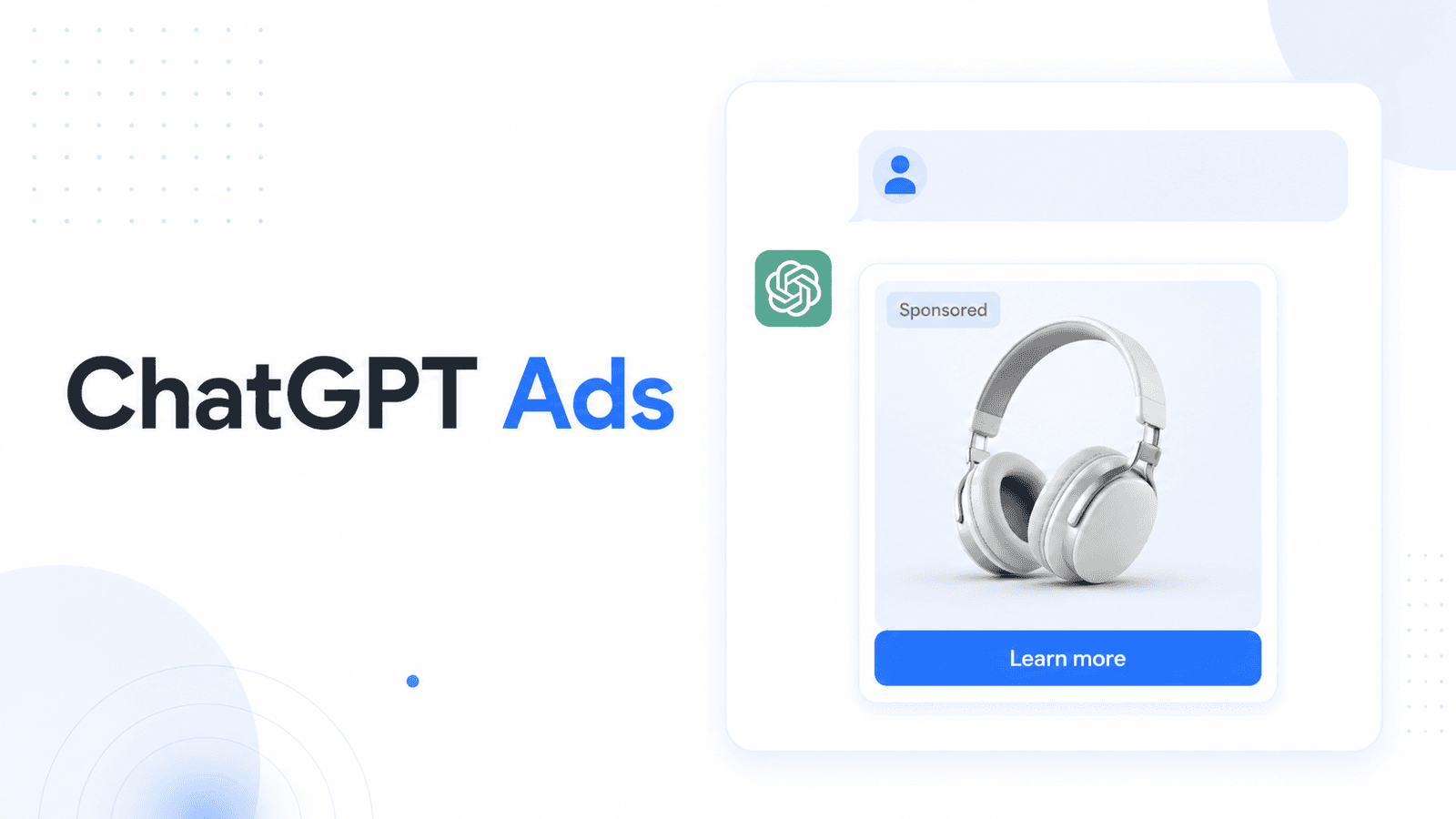
Ads appear below ChatGPT responses, clearly labelled as sponsored and visually separated from the response itself. According to OpenAI’s documentation, an ad can include the advertiser’s name, logo or favicon, headline, description, landing page and visual.
OpenAI also supports product-feed campaigns that pull product names, prices, availability, images and destination URLs from a catalogue. For e-commerce advertisers, it is particularly useful that OpenAI uses a product data format compatible with Google. Webshops that already maintain a high-quality Google Shopping feed therefore have a strong foundation for this channel.
Ads do not change ChatGPT responses. OpenAI explicitly states that the advertising system and the model generating responses are separate, that advertisers do not receive user conversations and that the appearance of an ad does not represent an endorsement of the brand by OpenAI.

Who sees the ads and who does not?
Ads are shown to users on Free and Go plans. Plus, Pro, Business, Enterprise and Edu plans remain ad-free. Ads are also not shown to accounts that OpenAI knows or estimates belong to people under the age of 18.
For B2B advertisers, this is an important limitation. The total number of ChatGPT users is not the same as the audience that ads can reach. Some professional users, managers and teams use paid or business plans that ChatGPT Ads will not reach.
Personalised ads are not available in Europe during the initial phase. Ads can still be connected to the context of the current conversation, but without broader signals from other conversations or a user’s history. This makes the quality of context hints, ad copy and landing pages even more important in Europe.
How are campaigns structured and optimised?
The structure follows a format familiar to Google and Meta advertisers: campaign, ad group and ad. The campaign defines the objective, budget, dates and markets. The ad group brings together a theme or area of intent. The ad contains the message, visual and destination page.
The most interesting element is context hints: descriptions of conversations, needs and situations in which a product or service is relevant. OpenAI recommends natural and specific wording. Instead of the broad phrase “running shoes”, a stronger hint would be “comfortable running shoes for beginners training for their first five kilometres”.
Context hints help the system understand the purpose of the ad, but they are not exact-match rules that guarantee delivery alongside specific words.
There are currently three main buying objectives:
- CPM / reach: payment per thousand impressions, optimised for reach
- CPC / clicks: payment per valid click, optimised for traffic
- oCPC / conversions: optimisation towards selected conversions, with billing per click rather than per conversion
For CPC campaigns, OpenAI recommends a starting maximum bid of $3 to $5 per click. This is guidance, not a market benchmark or promised CPC. The actual CPC depends on the market, category, relevance, competition and auction dynamics.
What does the platform offer for targeting and measurement?
Although the platform is still young, it already offers technical foundations that go beyond a simple experiment. Available options include current conversation context, advertiser context hints, geo-targeting, custom audiences, Pixel and Conversions API.
- current conversation context and identified intent
- geo-targeting at least at country level, with more granular options where supported
- custom audiences created from lists of email addresses or phone numbers, with inclusion, exclusion and bid adjustments
- OpenAI Pixel and Conversions API
- UTM parameters and an OpenAI click reference for connecting clicks with conversions
- measurement through selected third-party partners
Custom audiences require at least 25,000 matched users, while OpenAI recommends a minimum of 100,000. For most Croatian companies, this is a considerably higher threshold than on Google or Meta.
For web measurement, we recommend combining the Pixel with a server-side Conversions API, event deduplication, UTM parameters, GA4 and, where possible, CRM data or actual revenue and lead-quality data. OpenAI states that Conversions API provides more reliable data than the browser-based Pixel alone.
Landing pages must be accessible to OpenAI’s crawlers. Ads require OAI-AdsBot to be enabled, while OpenAI also recommends allowing OAI-SearchBot. This should be checked in the robots.txt file and in any CDN or bot-protection system.
What do early results from other markets really show?
Most importantly, OpenAI itself states that the platform does not yet have reliable benchmarks by industry, objective or campaign type. Publicly available data combines aggregated estimates, individual accounts and very small tests. It should be used to understand possible ranges, not to build firm business projections.
| Source and sample | Result | How to interpret it |
|---|---|---|
| Similarweb aggregated analysis | Overall CTR of 0.68%, median CTR per brand of 0.50%, top quartile of 1.0% and a best observed result of 5.4%. After an ad was displayed, 73% of conversations continued for at least four more messages | The broadest publicly available view of the market, but not a substitute for an individual advertiser’s conversion and profitability data |
The conclusion is not that ChatGPT Ads simply “works” or “does not work”. Early data shows a very wide range of results. The channel may deliver high-quality traffic and sales, but it remains volatile, lacks sufficient data for universal claims and creates a significant risk of drawing the wrong conclusions from small samples.
Why organic ChatGPT visibility should be developed alongside paid ads
Paid and organic presence in ChatGPT are not the same thing. ChatGPT ads do not increase organic visibility, influence the content of responses or mean that ChatGPT recommends the advertiser.
An ad buys a clearly labelled placement below a response. Organic visibility occurs when ChatGPT or another AI platform independently mentions, cites or recommends a brand based on available sources and signals.
This is exactly why it makes sense to work on both. If users see your competitors in organic responses and your brand only in sponsored cards, paid campaigns may still generate clicks, but the organic experience will not build the same level of trust in your favour. If your brand is already present in relevant responses, users may recognise it as a credible option before they even see an ad.
Campaign preparation should therefore include Search optimization that brings together SEO and GEO, or Generative Engine Optimization:
- Measure your initial AI visibility. Test whether your brand appears in ChatGPT and other AI platforms for commercially important queries. The Risely GEO Audit measures visibility across ChatGPT, Gemini, Perplexity, Google AI Overviews, Claude and Copilot.
- Build a shared intent map. The same groups of questions can provide the foundation for content, landing pages, context hints and ad messages.
- Strengthen verifiable signals. Clear product and service pages, comparisons, case studies, expert authors, reviews, data, citations and consistent brand information help both customers and AI systems understand relevance.
- Check technical accessibility. Important content must be accessible to crawlers, load quickly and clearly connect entities, products and authors. Use the GEO checklist for more details.
- Measure paid and organic performance separately. Traffic from ChatGPT ads should have its own UTM parameters and conversions, while organic traffic and AI visibility should be tracked as separate metrics.
If this is a new area for your business, read our guide to what GEO is and how it differs from SEO.
What can Croatian advertisers do now?
Self-service Ads Manager access using a Croatian legal entity and Croatian billing details is not yet available. Advertisers can register their interest and explore access through the OpenAI Ads Solutions team or partners involved in the European rollout.
If a client has a genuine legal entity in a country where self-service Ads Manager is available, the account should be opened for that entity using its correct business and billing information. The recommended approach is for a client representative to open the account and then grant the agency the appropriate access to create and manage campaigns.
Regardless of the access route, most of the preparation can be completed before spending a single euro:
- Define the route to platform access. Establish whether the client will access the platform through the OpenAI Ads Solutions team, an eligible partner or its own legal entity in a supported country.
- Define the questions and situations that precede a purchase. List the real problems, comparisons, limitations and use cases customers describe before choosing. Group them by intent and decision stage rather than simply copying Google Ads keywords.
- Check organic demand and AI visibility. Test whether users ask AI platforms about your category and which brands appear in the responses. If there are few relevant conversations in the category, paid inventory is also unlikely to have significant volume.
- Check policy compliance. Alcohol, tobacco, gambling, political advertising and other sensitive content are prohibited or heavily restricted, while financial, healthcare and legal services may require additional review. Always check the current OpenAI Ad Policies before preparing a campaign.
- Prepare relevant landing pages. Users arrive from conversations in which they have already described their problem. A generic homepage is often a poor choice. The page should immediately confirm that you solve the specific problem, provide evidence and lead towards a clear action.
- Prepare several genuinely different ads. Develop multiple headlines, descriptions and visuals covering different benefits and situations, rather than ten superficial variations of the same message.
- For e-commerce, prepare the product feed. Check product names, categories, prices, availability, GTINs, images and destination URLs. A high-quality Google Shopping feed is a strong starting point because OpenAI uses compatible specifications. Read more in our guide to Google Shopping ads arriving in Croatia.
- Prepare tracking before launching campaigns. Define conversions and how ads will be connected to revenue or lead quality using Pixel, Conversions API, deduplication, UTM parameters, GA4, consent management and, where possible, CRM data. If you are unsure whether your current measurement can be trusted, begin with a data and analytics audit.
- Agree on what the first test needs to prove. Do not judge performance on CTR or CPC alone. Define the primary business objective, acceptable CAC, CPL or ROAS, how lead quality will be assessed and how much data is needed before deciding whether to scale, adjust or stop.
- Register your interest. Companies can check availability and register their interest on the official ChatGPT Ads website. Do not open accounts using inaccurate addresses, another company’s legal information or billing details that do not belong to the actual advertiser.
How we would structure the first ChatGPT Ads test
For the first controlled test, we would recommend a simple structure: one clear business objective, two to four separate intent groups, a dedicated ad group for each intent, several specific context hints per group, at least three genuinely different creative angles, a relevant landing page for each group and complete measurement through Pixel, Conversions API and GA4.
The first test should not answer only one question: “What is the CPC?” It should show whether sufficient relevant inventory exists, what the traffic quality looks like, which conversation contexts align best with the offer and whether the channel generates profitable sales or qualified leads.
This is the same principle we apply to other performance channels: begin with business objectives, ensure reliable measurement, test in a controlled way and scale only when the data supports it.
Who does ChatGPT Ads make the most sense for?
The strongest early candidates are likely to be brands that solve clear and frequently described problems, offer products or services permitted under the advertising policies, already generate some organic traffic or ChatGPT mentions and can prepare specific landing pages and multiple creative approaches.
They also need reliable measurement, sufficient conversion volume and a controlled testing budget that does not take investment away from channels already delivering profitable results.
The channel may also be relevant for some B2B brands, particularly when potential customers use ChatGPT to research software, suppliers or business solutions. However, part of the professional audience uses paid or business plans without ads, so available inventory and volume may be lower than the total number of ChatGPT users suggests.
Frequently asked questions
How long does it take to open and approve a ChatGPT Ads account?
OpenAI does not provide a guaranteed review timeline. After business information has been submitted and verification completed, the application enters a review process. High application volumes may extend the waiting period, and submitting duplicate applications will not accelerate approval. The status should be monitored in Ads Manager and through the email address used during registration.
Can an agency open and manage a ChatGPT Ads account on behalf of a client?
An agency can create, manage and optimise campaigns once it has been granted the appropriate account access. The recommended approach is for the account to belong to the client and the genuine legal entity that is advertising and receiving the invoices. A client representative can open the account and then invite agency team members with the appropriate user roles.
If an agency accesses the platform as an official agency or technology partner, the onboarding process may differ and should follow the instructions provided by OpenAI for that access model.
Can one company have multiple ChatGPT Ads accounts?
Yes. Additional accounts can be used for different brands, legal entities or operating teams. Each new advertiser account currently needs to be created with a different email address. Once the accounts have been created, the same person can be invited as a member or administrator of multiple accounts.
Can the country, currency or time zone be changed later?
No. The country or region, billing currency and time zone are selected when the account is created and cannot subsequently be changed through self-service settings. If incorrect details are entered, a new account may be required. The legal entity, country, currency, time zone and billing information should therefore be confirmed before submitting the application.
How does ChatGPT Ads billing work?
ChatGPT Ads currently uses a postpay model. Spend accrues after ads have been delivered, and the saved payment card is charged when the account reaches its assigned payment threshold or at the end of the month if an outstanding balance remains.
The payment threshold determines when the card is charged and is not the same as the campaign budget. The billing details, address and payment method should correspond to the legal entity and country used to create the Ads Manager account.
What budget is needed for the first ChatGPT Ads test?
There is no universal test budget that makes sense for every brand. The appropriate amount depends on the objective, market, expected CPC or CPM, conversion rate and number of results required to make an informed decision.
The initial budget should be large enough to generate a meaningful sample of clicks and conversions, but controlled enough not to undermine investment in established, profitable channels. Before launching, define the maximum acceptable spend, the expected number of results and the criteria for stopping, adjusting or scaling the campaign.
Conclusion: the advantage will belong to advertisers prepared to test properly
ChatGPT Ads are already appearing in Croatia as part of the wider rollout across 31 European markets. For Croatian brands, the channel offers an opportunity to test a new performance channel while the platform, available inventory and competitive landscape are still developing.
The platform includes Ads Manager, CPM, CPC, conversion optimisation, geo-targeting, custom audiences, product feeds, Pixel, Conversions API and third-party measurement partners. That is enough for serious advertisers to begin treating it as a new performance channel, but not as a ready-made replacement for mature platforms such as Google and Meta.
Self-service access for Croatian legal entities is not yet available, but that is not a reason to delay preparation. Brands can already measure their organic AI visibility, define customer questions and intent, improve SEO and GEO, and prepare landing pages, creative, product feeds, tracking and clear rules for the first test.
The advantage will not belong only to the advertiser that is first to click “Launch campaign”. It will belong to the advertiser that has already prepared strong signals, relevant content, reliable measurement and a clear answer to what the first test needs to prove.
Want to prepare your brand for ChatGPT Ads while improving your organic visibility in ChatGPT and other AI platforms? Contact us. We can combine a GEO audit, intent mapping, measurement, landing pages and a first campaign plan into one clear readiness roadmap.
Read next: Google Shopping ads are coming to Croatia · What GEO is and how it differs from SEO